
Square Light designs are moving beyond simple ceiling panels. In 2026, buyers can choose recessed square downlights, slim surface-mounted fixtures, modular LED panels, and smart-enabled models. Each type suits a different job. A recessed fixture sits nearly flush with the ceiling, while a surface-mounted square light works where ceiling cavities are shallow. In offices, larger panels can provide broad, even illumination. Small details matter: ceiling height, room size, glare control, dimming, and color temperature can change how a fixture feels after dark.
Efficiency is part of the decision, but product-level claims deserve careful reading. The U.S. Department of Energy’s Energy Saver guidance states that LEDs use at least 75% less energy and last up to 25 times longer than incandescent lighting. Those figures describe LED technology broadly, not every square fixture or installation. The DOE’s solid-state lighting research also emphasizes performance factors such as efficacy, lifetime, and light quality. Meanwhile, the IEA’s Energy Efficiency 2023 report treats efficient lighting as one part of wider efforts to reduce energy demand. Useful context, not a product ranking.
This guide compares the leading Square Light types by installation, application, and practical performance. It also considers where each option may fall short, from uneven brightness to difficult replacement access. Specs can look convincing on a screen. The room tells the truth.
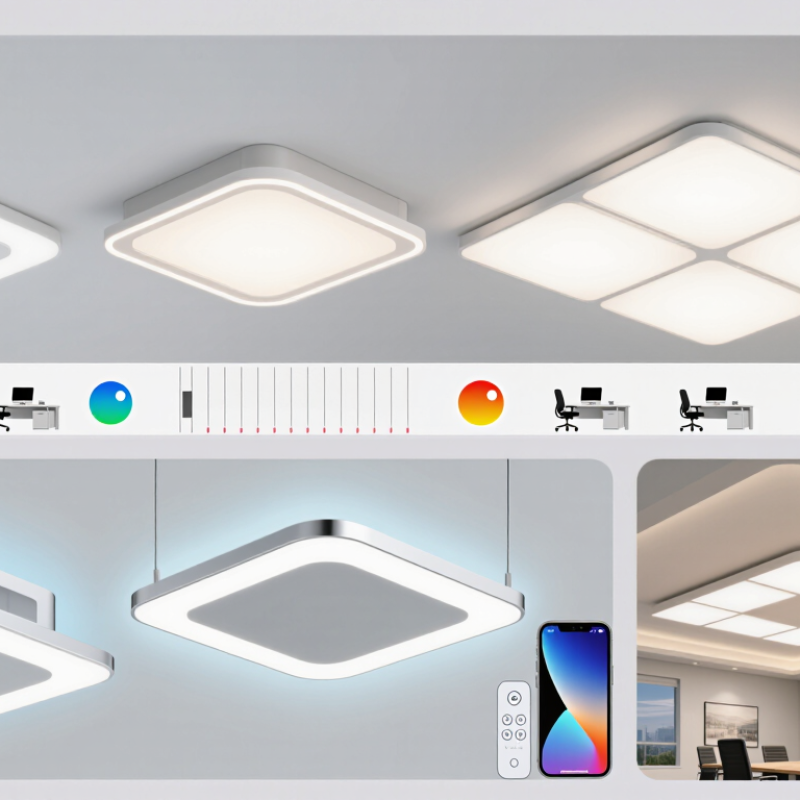
A square light is a fixture with a square frame, diffuser, or illuminated panel. It may sit flush in a ceiling, mount on a surface, hang as a pendant, or appear on a wall. Its geometry helps align lighting with ceiling grids, desks, and kitchen islands. The shape alone does not guarantee even illumination: lens design, beam spread, and placement matter. A poorly positioned panel can leave a bright patch on the floor and shadows on a work surface.
Square lights are used in offices, classrooms, kitchens, corridors, and retail spaces. Recessed panels provide broad, low-profile general lighting, while smaller square fixtures can highlight an entryway or wash a wall. For selection, check lumens, color temperature, dimming compatibility, and glare control—not just wattage. The U.S. Department of Energy reports that LEDs use at least 75% less energy and last up to 25 times longer than incandescent lighting. That comparison supports choosing efficient light sources, but it does not replace checking a fixture’s actual output and rated life.
Tips: Match the fixture size to the room and ceiling grid. Test the light at the time of day you use the space most. One detail is easy to miss: a cool-looking finish can make a room feel harsher than expected. A sample helps.
Square lights in 2026 come in several practical forms, and the right choice depends on ceiling height, room use, and installation needs. Recessed square downlights sit nearly flush with the ceiling, creating a tidy look in kitchens, hallways, and bathrooms. They work well for focused pools of light, but the ceiling cavity must have enough space for the fitting and wiring. Check the product’s damp-location rating before using it near showers.
Surface-mounted square lights attach directly to the ceiling. Their shallow profile suits concrete ceilings or renovation projects where cutting a recess is difficult. Square LED panels are a common option for even, broad illumination in offices, utility rooms, and kitchens. Some models support dimming or adjustable color temperature; compatibility with the wall control should be confirmed before purchase. Details matter.
Pendant lights use a suspended square shade or frame, often above a dining table or island. They make the fixture more visible and bring light closer to a work surface. Square wall lights provide accent or bedside lighting, while outdoor square fixtures can illuminate entrances and covered patios. Outdoor ratings vary, so verify exposure requirements rather than relying on appearance. The categories sometimes overlap, and that can be confusing. A simple sketch of the room, ceiling height, and desired beam direction can help narrow the options.
Typical wattage ranges for common square LED light types
Ranges are representative examples, not market averages. Actual wattage varies with size, brightness, efficiency, and product design. Choose a light based on the required illumination and installation location.
Square lights differ in how they sit, spread light, and manage heat. A recessed square downlight fits into a ceiling cutout, leaving a neat, low-profile finish. Its focused beam suits kitchen counters or hallways, but poor placement can create harsh bright spots. Clean ceiling lines.
Surface-mounted fixtures attach directly to the ceiling, making them practical where there is little room above it. Their visible frames can add a deliberate geometric detail. Flat LED panels usually give broader, more even illumination across work areas. They may feel less decorative, though. Not always.
Outdoor square fixtures often use sealed housings to resist moisture and dust. Check the product’s protection rating and temperature guidance for the intended location. For any type, compare light output, color temperature, dimming compatibility, and glare control—not wattage alone. A diffuser can soften light, while a deep-set lens may reduce direct glare. In real rooms, wall color and ceiling height change how bright a fixture feels. That part is easy to underestimate, and specifications cannot fully predict the result.
| Square Light Type | Design and Installation | Typical Light Output | Typical Efficacy | Performance Characteristics | Common Applications | Main Consideration |
|---|---|---|---|---|---|---|
| Recessed LED Panel | Thin, flat square panel set into a suspended ceiling grid or a prepared ceiling opening. Edge-lit and back-lit constructions are both common. | About 2,000–6,000 lumens, depending on size and power | Approximately 90–130 lm/W | Broad, relatively even light distribution with a low-profile appearance. Dimming and selectable color temperature are available on some models. | Offices, classrooms, healthcare spaces, and other indoor areas with grid ceilings | Requires a compatible ceiling opening or grid; glare control and diffuser quality affect visual comfort. |
| Surface-Mounted Square Panel | Flat panel attached directly to the ceiling, often with a frame or surface-mount kit. Suitable where a recessed cavity is unavailable. | About 1,500–5,000 lumens | Approximately 85–125 lm/W | Provides wide ambient illumination and a clean, simple profile. Installation is generally straightforward on suitable solid ceilings. | Corridors, apartments, utility rooms, retail spaces, and retrofit projects | The fixture sits below the ceiling plane; check its depth and mounting method before installation. |
| Square LED Troffer | A recessed ceiling fixture designed for modular ceiling systems; typically has a deeper housing and a lens, diffuser, or controlled-lighting optic. | About 3,000–7,000 lumens | Approximately 100–140 lm/W | Designed for general task lighting, with versions offering better glare control or compatibility with dimming and lighting controls. | Offices, schools, clinics, and commercial buildings | Confirm ceiling-grid dimensions, distribution pattern, and compatibility with existing controls when replacing a fixture. |
| Square LED Downlight | Compact recessed fitting with a square trim and a directional or semi-directional optic. Some versions use a fixed integrated LED module. | About 600–2,500 lumens | Approximately 70–110 lm/W | Creates more focused illumination than a flat panel and can emphasize counters, circulation paths, or architectural details. | Homes, hospitality spaces, meeting rooms, and accent or task-lighting layouts | Beam angle and spacing strongly affect uniformity; a suitable ceiling cavity and thermal clearance may be required. |
| Square Bulkhead Light | Robust surface-mounted fitting with a sealed housing, often designed for ceilings or walls in exposed or damp locations. | About 800–3,500 lumens | Approximately 75–115 lm/W | Built for practical area lighting; models intended for exterior or wet locations commonly specify an ingress-protection rating. | Porches, stairwells, service areas, garages, and sheltered outdoor spaces | Check the stated IP rating, operating temperature range, and suitability for the exact exposure conditions. |
Values are typical indicative ranges, not guaranteed specifications. Actual output and efficacy vary by fixture size, wattage, optics, color temperature, driver, and testing method. Compare product data sheets and applicable local requirements before selection.
Square recessed lights suit kitchens, bathrooms, and hallways where a clean ceiling matters. Their focused beams work well over sinks or along narrow walkways, but spacing affects comfort. Too many can create a runway effect. Square LED panels spread light evenly across offices, classrooms, and utility rooms. They are especially useful where people read screens or papers for long periods. The U.S. Department of Energy’s Energy Saver guidance says LEDs use at least 75% less energy and last up to 25 times longer than incandescent lighting. That comparison supports efficient choices, though actual savings depend on use and installation.
Surface-mounted square fixtures work best in low ceilings or rooms without space for recessed housings, such as closets and older apartments. Square pendants give direct light over kitchen islands and dining tables; hang them high enough to keep sightlines clear. Wall-mounted square lights can soften entryways and corridors, but they rarely replace ceiling lighting. A tidy grid may still feel clinical. Test the layout before committing.
Tips: Match the fixture’s brightness to the task, not just the room size. Check glare from seated eye level. For kitchens, use task lighting over work surfaces; for bedrooms, choose softer, dimmable light. Don’t assume every square fixture spreads light evenly—lens design and mounting height matter.
Choosing a square light starts with the ceiling and the job the room needs it to do. Recessed square downlights suit low ceilings and clean lines. Surface-mounted panels spread light across kitchens, offices, or utility rooms. A square pendant can define a dining table, while an adjustable gimbal directs light onto artwork or a workbench. Small room? Choose a shallow fixture. Check the beam angle, too: a narrow beam can leave dark corners.
Match brightness to the task, then consider glare, dimming, color temperature, and color rendering. The U.S. Department of Energy’s LED lighting guidance reports that LEDs use at least 75% less energy and can last up to 25 times longer than incandescent lighting. The International Energy Agency estimates that lighting accounts for about 15% of global electricity consumption. Those figures favor efficient LEDs, but they do not guarantee a comfortable room. A square fixture can look tidy on a plan and still feel harsh above a glossy table.
Tips: Hold a paper sample at ceiling height to judge scale, and check the fixture’s lumen output rather than its wattage. For bathrooms or covered outdoor areas, verify the damp- or wet-location rating. If possible, test the color temperature after dark. Warm light often feels calmer; cooler light can make task areas easier to read. Not every room needs the same setting.
