
China Top 10 Prefabricated Substation Manufacturers
China’s power system is expanding, and equipment must keep pace with new generation, industry, and urban demand. A Prefabricated Substation can shorten on-site installation by integrating key equipment in factory-built enclosures. Yet speed is only useful when protection, thermal performance, and commissioning are handled well.
The International Energy Agency’s 2023 report, Electricity Grids and Secure Energy Transitions, estimates that more than 80 million kilometres of grids must be added or refurbished worldwide by 2040. It also says annual grid investment needs to exceed US$600 billion by 2030, up from about US$300 billion. These figures do not measure China’s prefabricated-substation market directly. They do show why dependable, deployable grid equipment matters.
This guide introduces ten Chinese manufacturers for buyers comparing engineering capability, product range, and project support. Look beyond brochures. Ask about transformer ratings, switchgear configuration, relay protection, enclosure materials, factory acceptance tests, and spare-parts access. A compact skid beside a dusty industrial yard may face very different demands from a substation serving a coastal city. Details matter.
Rankings can simplify a crowded market, but they cannot replace project-specific checks. The list is a starting point, not a verdict. Some information may also change as product lines and certifications evolve. Verify current specifications directly with each manufacturer before making a shortlist.
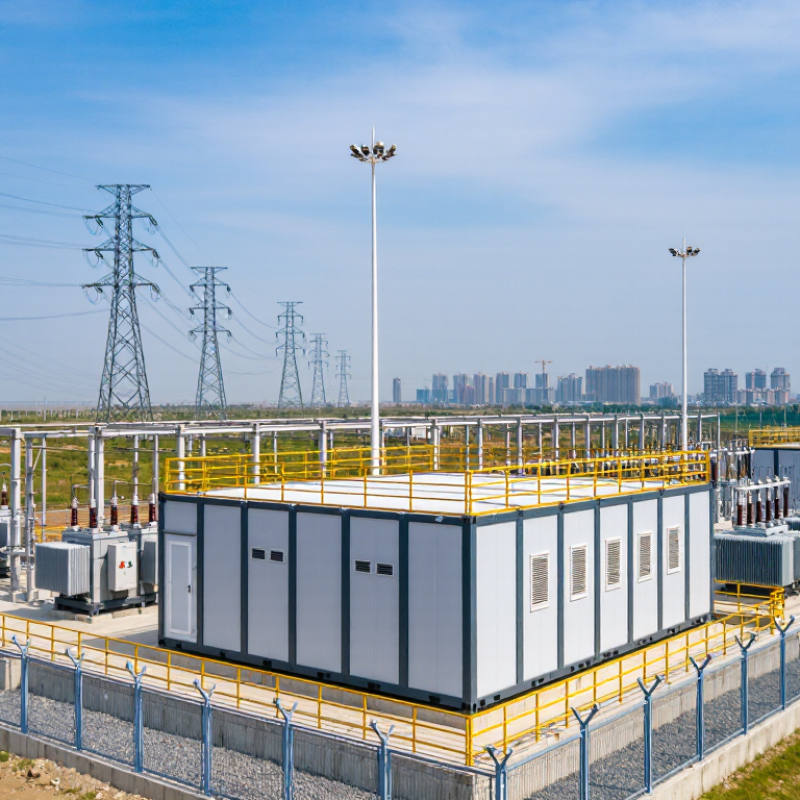
What Prefabricated Substations Are and How They Work
A prefabricated substation is a compact electrical facility assembled from factory-built modules. It typically houses a transformer, medium- or low-voltage switchgear, protection relays, control equipment, and auxiliary systems. The package may sit inside a metal enclosure or on a transportable skid. Its exact layout depends on voltage, capacity, climate, and site conditions.
At the site, crews position the unit, connect incoming and outgoing cables, and verify grounding, protection settings, and control signals. During operation, the transformer changes voltage for distribution or local use. Switchgear routes power, while relays detect abnormal current and signal circuit breakers to isolate faults. Operators can monitor key readings locally or through a remote control system. Small details matter: cable entry points, ventilation, and space for maintenance can shape reliability.
The International Energy Agency’s 2023 report, Electricity Grids and Secure Energy Transitions, estimates that about 80 million kilometres of grids must be added or refurbished by 2040. It also says annual grid investment needs to exceed 600 billion US dollars by 2030. Prefabricated designs can help shorten on-site assembly, but they do not remove the need for careful engineering. A rushed interface check can still cause delays. Factory testing is useful, not magic; site acceptance tests remain essential.
| Application | Typical system voltage | Indicative transformer capacity | Typical equipment arrangement | Common design considerations |
|---|---|---|---|---|
| Urban residential distribution | 10 kV / 0.4 kV | 315–1,250 kVA | Medium-voltage switchgear, distribution transformer and low-voltage board in a compact enclosure | Low noise, limited site footprint, safe public access and coordination with the local distribution network |
| Commercial buildings and shopping centers | 10 kV / 0.4 kV | 630–2,000 kVA | Incoming medium-voltage equipment, one or more transformers and outgoing low-voltage feeders | Load growth, ventilation or cooling, fire protection and access for inspection and replacement |
| Industrial plants and workshops | 10 kV / 0.4 kV | 800–2,500 kVA | Switchgear, transformer and low-voltage distribution sections; multiple units may be used for larger loads | Motor-starting demand, harmonic loads, protection coordination and separation of critical circuits |
| Public infrastructure and transport facilities | 10 kV / 0.4 kV | 400–1,600 kVA | Packaged transformer and switchgear arrangement supplying facility distribution boards | Continuity of service, emergency-load requirements, restricted access and environmental conditions at the site |
| Rural and peri-urban distribution | 10 kV / 0.4 kV | 100–630 kVA | Compact switchgear and transformer package sized to the local distribution load | Outdoor weather protection, maintainability, lightning protection and allowance for future demand |
| Solar photovoltaic plant auxiliary supply | Typically 10 kV / 0.4 kV for auxiliary loads | 100–1,000 kVA | Distribution transformer with medium- and low-voltage equipment for plant services | Dust and temperature exposure, remote monitoring and separation of auxiliary supply from generation step-up equipment |
| Wind farm auxiliary supply | Typically 10 kV / 0.4 kV for site services | 100–1,000 kVA | Packaged distribution equipment serving control buildings and other auxiliary loads | Wind, moisture, corrosion protection, remote operation and the project’s specific grid-connection design |
| Data centers and telecommunications facilities | 10 kV / 0.4 kV | 630–2,500 kVA | Transformer and distribution sections arranged to feed defined electrical load groups | Redundancy strategy, selective protection, heat management and coordination with backup power systems |
| Ports, logistics parks and large warehouses | 10 kV / 0.4 kV | 400–2,000 kVA | Medium-voltage incoming section, transformer and low-voltage feeder board | Outdoor exposure, vehicle access, enclosure placement and provision for changing operational loads |
| Temporary construction and project sites | 10 kV / 0.4 kV, where network conditions permit | 100–1,000 kVA | Transportable packaged equipment with distribution outlets or feeder connections | Relocation needs, cable routing, mechanical protection and compliance with temporary-site electrical rules |
Prefabricated substations combine medium-voltage switching equipment, a transformer and low-voltage distribution equipment in a factory-assembled enclosure. The medium-voltage section receives and switches power, the transformer changes voltage, and the low-voltage section distributes power to downstream circuits. Voltage levels, capacities, enclosure ratings and protection schemes vary by project; the ranges above are indicative examples and require engineering verification for a specific site.