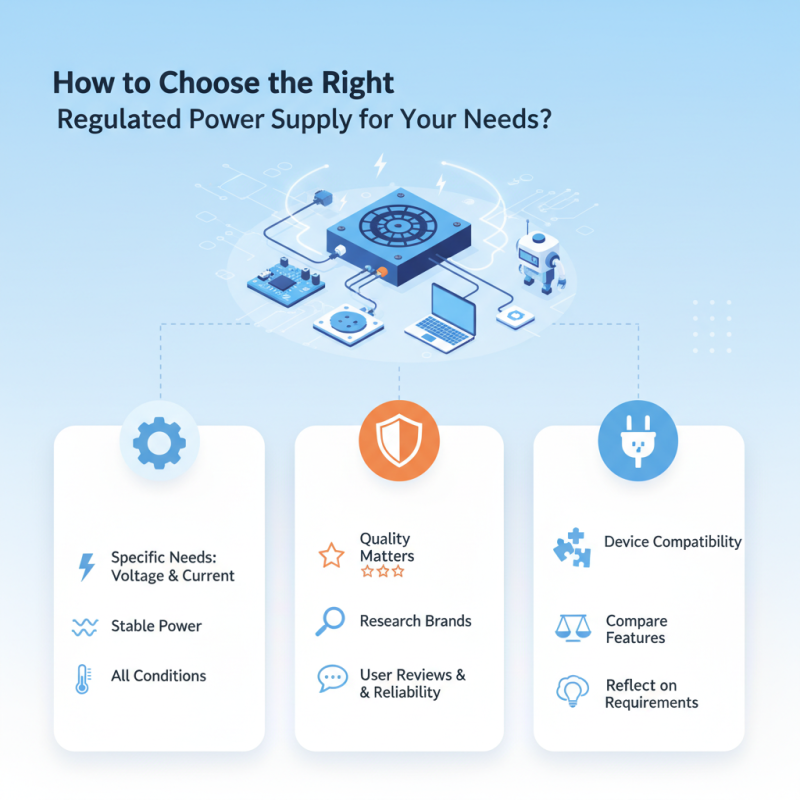
How to Choose the Right Regulated Power Supply for Your Needs?
Choosing the right Regulated Power Supply requires careful consideration. It is essential to understand your specific needs. Different applications have varying power requirements. Identifying voltage and current needs is crucial. Ensure the supply can deliver stable power under all conditions.
Quality matters when selecting a Regulated Power Supply. Low-quality options may lead to equipment malfunction. This can cause disruptions and increased costs. It's important to research reputable brands. User reviews can provide insight into reliability and performance.
Compatibility with your devices cannot be overlooked. A mismatch can lead to inefficiency or damage. Sometimes, users overlook this simple detail. Not all supplies are created equal. Taking the time to compare features pays off in the long run. Reflection on your specific requirements will enhance your selection process.
Understanding the Basics of Regulated Power Supplies
When selecting a regulated power supply, understanding the fundamentals is essential. A regulated power supply provides a constant output voltage, despite variations in input voltage or load conditions. This feature is critical for electronics that require stable power to operate reliably. They are used in various applications, from simple circuits to sophisticated systems.
The core components of a regulated power supply include transformers, rectifiers, and voltage regulators. Transforming the voltage is the first step. Then, the rectifier converts AC to DC. Finally, voltage regulators ensure the output remains stable. Even small fluctuations in voltage can lead to malfunction. Knowing how these components work helps in identifying the right power supply for your project.
Not all power supplies are equal. Consider factors like output voltage and current ratings. Are they sufficient for your needs? Sometimes a power supply might seem perfect initially but later reveals limitations. Take time to reflect on your specific requirements. The challenge lies in balancing performance with reliability. Adjustments may be necessary as projects evolve.
Identifying Your Specific Power Requirements
When selecting a regulated power supply, understanding your specific power requirements is crucial. Begin by determining the voltage and current needed for your devices. For example, many electronics operate at 5V or 12V, while others might require a higher voltage. According to a report by the International Energy Agency, devices consume a significant amount of energy. An improperly matched power supply can lead to inefficiencies or even damage to your equipment.
Consider the total wattage your system will demand. If your setup requires a total of 100 watts, choose a power supply with at least a 20% overhead to ensure stability. A study from the Electric Power Research Institute found that underloading or overloading power supplies can reduce their lifespan by up to 50%. Additionally, pay attention to the ripple and noise specifications. A high ripple can disrupt sensitive electronic components.
Don’t forget about environmental factors. If you're in a high-temperature area, make sure the power supply can handle those conditions. Sometimes, manufacturers list the operating temperature ranges, but those specs may not reflect real-world scenarios. Always account for additional heat generated during operation. Make informed decisions based on your exact needs to prevent future complications.
Evaluating Different Types of Regulated Power Supplies
When selecting a regulated power supply, consider the various types available. Linear power supplies provide a steady output voltage. They are simple and reliable but can be bulky. On the other hand, switching power supplies are more efficient. They can convert voltage levels and reduce energy loss, but they might introduce noise into your circuits.
Each type has its advantages and drawbacks. A linear supply may heat up and require more space. Meanwhile, a switching supply's noise could affect sensitive equipment. Think about your specific needs. Is efficiency more important, or is stability crucial for your project?
In some cases, users overlook the required current ratings. This can lead to underperformance. Make sure to match the power supply to your devices. Additionally, consider protection features to avoid overloads. Finding the right balance between performance and cost is not straightforward. Reflect on the environments in which you will use the power supply.
Considering Efficiency and Thermal Management
When selecting a regulated power supply, efficiency is paramount. A high-efficiency power supply minimizes wasted energy. According to the U.S. Department of Energy, implementing efficient power supplies can lead to over 30% energy savings in some applications. This is crucial in sectors with high power consumption, like telecommunications and data centers, where even small savings compound significantly.
Thermal management also plays a critical role in performance. Poor thermal management can shorten the lifespan of components. For example, a report from the Electric Power Research Institute (EPRI) indicates that inadequate cooling can reduce a power supply's efficiency by up to 20%. Therefore, designs should incorporate sufficient heat dissipation mechanisms. Fans, heat sinks, or temperature monitoring systems can help maintain optimal operating conditions.
It's essential to evaluate the trade-offs between efficiency and heat management. Some high-efficiency designs might generate unexpected heat under specific loads. Understanding this balance can lead to better long-term reliability. In the end, a meticulously chosen regulated power supply offers not just functionality but also stability in performance.
Key Features to Look for in a Regulated Power Supply
When selecting a regulated power supply, it's essential to focus on key features that suit your specific applications. Start with the output voltage range. It should match your device's requirements. Look for supplies that offer adjustable outputs, as this flexibility can come in handy. A wide voltage range can accommodate various components.
Another important feature is current capacity. Ensure the power supply can deliver sufficient current without overheating or shutting down. Check the specifications for both continuous and peak current ratings. Consider if you need a power supply with overload protection, which can help prevent damage during surges.
Efficiency is another critical aspect. Look for models that minimize energy loss. Higher efficiency often means lower operating costs. Noise levels matter too. Some devices are sensitive to electrical noise, so a power supply with low ripple voltage can help maintain device performance.
It's worthwhile to reflect on the ambient temperature where the power supply will operate. Make sure it can handle those conditions without compromising reliability.