
Choosing the right Sport Smart Glasses involves more than comparing prices or counting features. These glasses may display navigation, record training data, play audio, or support hands-free communication. However, useful technology should improve your workout, not distract from it. Visibility comes first. A clear lens, secure fit, and stable frame matter during fast cycling, trail running, or changing weather.
This guide examines the details experienced athletes often notice after several training sessions. We will consider battery life, display brightness, control placement, sweat resistance, lens quality, weight, and phone compatibility. Comfort matters. A pair that feels impressive in a shop may become uncomfortable after two hours under direct sunlight. Check the manufacturer’s specifications, warranty, safety information, and software support before buying. Independent reviews can also reveal problems that product pages overlook.
Real-world testing remains important. Try wearing the glasses with your helmet, earbuds, or prescription lenses. Test the controls while moving, but never allow a display to replace careful attention to traffic, terrain, or other people. Some features sound valuable yet add little during actual training. That is easy to underestimate. Personal preferences also change between sports, seasons, and fitness levels. A runner may value light weight, while a cyclist may prefer navigation and wind-resistant audio.
No single model suits everyone. Even expert recommendations have limits. Use this comparison as a practical starting point, then judge each option against your sport, routine, eyesight needs, and comfort expectations. The best Sport Smart Glasses should feel dependable, understandable, and helpful when conditions become difficult.
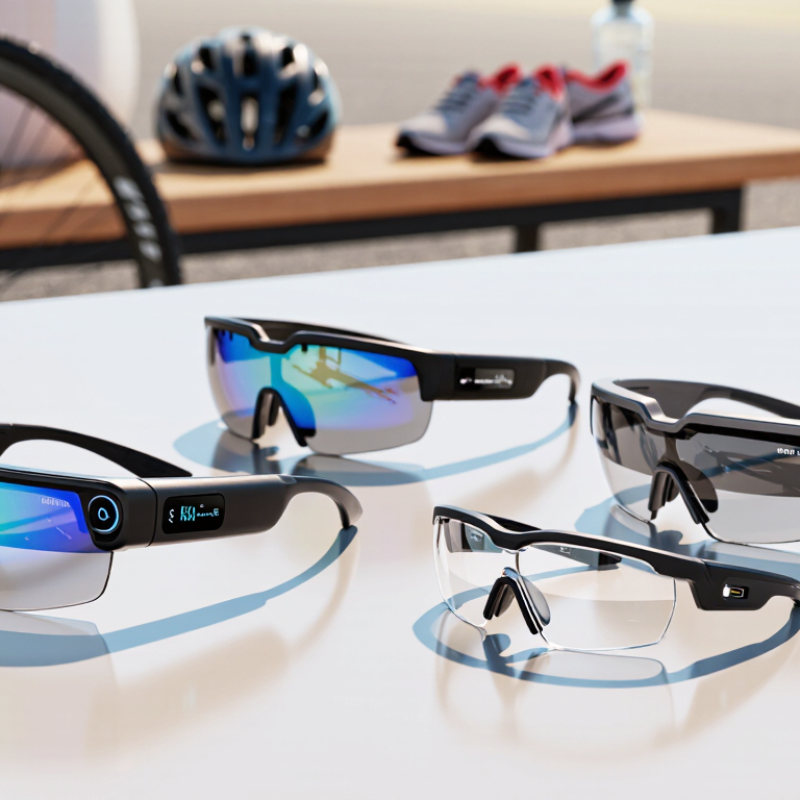
Choosing sport smart glasses starts with defining the core features, not counting fashionable extras. The frame should stay stable during running, cycling, or sudden head movement. Weight matters too. A few grams can become uncomfortable after an hour. Look for balanced hinges, adjustable nose support, and lenses suited to changing light.
Battery life must match real training time. A device lasting four hours may fail during a long ride. Sensors should record useful metrics, such as speed, distance, heart rate, and navigation data. The International Data Corporation’s 2024 AR/VR market analysis identifies comfort, battery life, and practical applications as key adoption barriers. That aligns with field experience: bright displays mean little when sweat reaches the controls.
Audio and safety need equal attention. Open-ear sound can provide coaching while preserving awareness of traffic and nearby athletes.
The National Highway Traffic Safety Administration reports that distracted driving caused 3,308 deaths in the United States in 2022, so controls should be simple and voice use should never replace visual attention.
Check water and dust resistance under IEC 60529 ratings, rather than trusting vague “sports-ready” wording. Privacy also deserves scrutiny. A 2024 Deloitte connected-consumer report found that data security remains a significant concern for wearable users.
I would inspect microphone indicators, storage settings, and deletion controls before purchase.
Some advertised features still feel experimental. That is worth admitting.
Choosing sport smart glasses starts with the lens, not the display. Outdoor Industry Association’s 2024 report recorded 175.8 million U.S. outdoor participants in 2023. Their environments vary sharply, from reflective water to shaded forest trails. Polarized lenses can reduce glare on lakes, roads, and snow. However, they may weaken visibility on some digital screens. That limitation deserves testing before purchase. Photochromic lenses suit cyclists moving between sunlight and tunnels, but their transition speed can feel slow. Amber or copper tints often increase trail contrast. Clear lenses work better for night riding or heavily shaded routes. Light changes fast.
Your environment should also shape the frame and lens protection. Look for impact-rated eyewear meeting recognized standards, such as ANSI Z87.1 or EN 166. Anti-fog treatment matters during steep climbs, especially when sweat meets cold air. Ventilation can help, although poorly designed vents may admit dust. The World Health Organization estimates that 2.2 billion people live with near or distance vision impairment. Prescription compatibility is therefore a practical requirement, not a luxury. Check whether the smart glasses support your prescription and retain accurate optical alignment. A darker lens is not automatically safer; verify its UV protection rating. I have found that touch controls become frustrating with wet gloves, so voice commands deserve real-world testing. Indoor trials can mislead you. Wear the glasses outside, move quickly, and inspect glare, contrast, fogging, and battery visibility before committing.
Match lens technology to your sport and environment by considering visible light transmission (VLT), glare, contrast, and changing light conditions.
The chart shows representative VLT targets for common outdoor conditions. Lower VLT is suitable for brighter environments, while higher VLT helps in overcast or low-light conditions. Polarized lenses can reduce reflected glare on water and roads; photochromic lenses adapt to changing light; contrast-enhancing and anti-fog treatments can improve visibility on trails and during temperature changes. Actual lens selection should also account for weather, altitude, eye sensitivity, and local safety requirements.
Compare Comfort, Fit, Durability, and Weather Resistance
During a long ride, comfort matters more than impressive specifications. I test smart glasses for at least an hour, not five minutes. Pressure behind the ears becomes obvious after climbing. A stable frame should stay put when I turn my head or look down. Nose pads should grip without leaving red marks. Try them with your usual helmet. My first pair felt secure indoors but shifted under a sweaty strap. That mistake changed how I judge fit.
Durability begins with hinges, frame joints, and lens protection. Flex the temples gently; they should resist, not creak or feel brittle. A scratch-resistant lens helps, but no coating is invincible. Store the glasses in a hard case after muddy sessions. Check whether replacement parts and care instructions are available. Product claims need careful reading. Drop tests may not represent a rocky trail.
Weather resistance deserves specific evidence. Look for a clearly stated water and dust rating, then check its test conditions. An IP rating does not promise safety against every storm, pressure washer, or saltwater splash. Sweat can enter through charging ports and buttons. Rain also causes lens fogging when warm skin meets cold air. Ventilation and anti-fog treatment matter. Battery performance may fall in cold weather. I sometimes overvalue ruggedness and forget daily comfort. On a cold, wet morning, those small checks matter more than a glossy specification sheet.
Battery life decides whether sport smart glasses help or become unused equipment. Test them during a real training session, not only at home. GPS, audio, cameras, displays, and voice controls can drain power quickly. A practical target is six to eight hours of mixed use. Longer endurance matters for cycling, hiking, and outdoor events. Check charging time too. A device needing two hours to recharge may disrupt your routine.
Connectivity deserves equal attention. Bluetooth SIG’s 2024 Market Update projects more than five billion Bluetooth device shipments annually by 2028. That growth supports wider accessory compatibility, but it does not guarantee stable connections. Test pairing with a phone, heart-rate monitor, and wireless earbuds. Walk behind a wall and check whether audio cuts out. Outdoor interference is easy to underestimate. GSMA’s Mobile Economy 2024 report counted 4.7 billion mobile internet users in 2023, showing how central mobile networks are to connected experiences. Still, smart glasses should retain basic functions when your phone signal disappears.
Tips: Check battery performance with brightness, navigation, and calls enabled. Confirm water resistance for sweat, not just light rain. Review privacy settings before recording. Voice commands should work with wind and traffic nearby. Try the controls while wearing gloves. Small details matter. I once trusted a battery estimate that ignored cold weather; it failed early. That mistake changed my testing method. Also question unnecessary functions. Translation, training prompts, and live data sound useful, but extra features can add weight, heat, and distraction.
| Evaluation Dimension | Recommended Target | Why It Matters for Sport | Practical Test | Priority |
|---|---|---|---|---|
| Battery life during active use | At least 6–8 hours with audio, sensors, or display enabled | Supports a full training session, race, or long outdoor ride without interruption. | Test with music, wireless connection, and the main smart functions active at normal volume or brightness. | Essential |
| Charging time and charging case | Full charge in approximately 1–2 hours; case provides at least one additional charge | Fast recovery between workouts is useful when access to a power outlet is limited. | Check whether the case uses a standard USB connection and whether charging can be completed before training. | High |
| Wireless connectivity | Bluetooth 5.0 or newer with stable low-energy operation | Improves connection stability with smartphones, watches, heart-rate sensors, and earbuds. | Walk 8–10 meters from the phone and check for audio dropouts or delayed notifications. | Essential |
| GPS and activity tracking | Built-in multi-constellation GPS, or reliable phone-assisted GPS | Enables route recording, distance measurement, pace tracking, and navigation support. | Compare recorded distance and route accuracy with a trusted sports watch or phone. | High |
| Smart notifications and controls | Call alerts, message previews, music control, and customizable touch or voice commands | Reduces the need to reach for a phone while running, cycling, or training outdoors. | Test controls with gloves, sweaty fingers, and during movement. | High |
| Audio quality and wind resistance | Open-ear or directional audio with clear speech and effective wind-noise reduction | Maintains situational awareness while allowing music, coaching cues, or calls. | Listen and make a call in moderate wind while keeping traffic and environmental sounds audible. | High |
| Display or heads-up information | Readable data such as pace, speed, turn prompts, or notifications in bright and low-light conditions | Allows quick access to essential data without looking down at a phone or wrist device. | Check readability in direct sunlight, shade, and while wearing a helmet or sweatband. | Optional |
| Water and sweat resistance | At least IPX4 for general exercise; IPX5 or higher for heavy rain and intense training | Protects electronics from sweat, splashes, and changing outdoor weather. | Confirm the official rating and avoid immersion unless the manufacturer explicitly permits it. | Essential |
| Fit, weight, and stability | Lightweight construction, secure temple grip, and balanced weight distribution | Prevents slipping, pressure points, and distraction during high-impact movement. | Wear for at least 30 minutes and perform running, head turns, and cycling-position checks. | Essential |
| Lens and visibility options | UV protection, impact-resistant lenses, and interchangeable or photochromic options | Improves comfort and visual clarity across changing light conditions. | Check UV protection, glare control, optical clarity, and compatibility with prescription lenses. | High |
| App compatibility and data export | Compatibility with major mobile operating systems and common fitness data formats | Makes it easier to review workouts and combine data from different sports devices. | Check synchronization, privacy controls, firmware updates, and export options before purchase. | Medium |
| Safety and privacy controls | Visible recording indicator, microphone controls, data permissions, and distraction-free modes | Helps protect personal data and supports safer use around traffic and other people. | Review privacy settings and confirm that recording, microphones, and notifications can be disabled quickly. | Essential |
Note: Recommended values are practical benchmarks for sports use. Actual performance varies with brightness, volume, GPS activity, weather, temperature, smartphone connection quality, and enabled smart functions.
Safety should guide every comparison, especially during cycling, running, or skiing. Choose lenses with strong impact resistance, clear peripheral vision, and secure frames that stay stable during sudden movement. Look for documented safety testing, not vague marketing language. Fit matters. A practical outdoor test reveals slipping, pressure points, and distracting reflections better than a showroom mirror.
Compatibility affects daily use more than many buyers expect. Check support for your phone’s operating system, Bluetooth version, navigation apps, and prescription lens options. Test the controls with sweaty hands and gloves. Some glasses connect quickly indoors but become unreliable near crowded roads or stadiums. That weakness deserves attention. Weather resistance, battery life, charging time, and microphone performance also shape real-world reliability.
Price alone misleads. Compare the full ownership cost, including replacement lenses, charging accessories, repairs, and warranty coverage. A cheaper pair may lose value if its battery declines quickly or software updates stop early. I once treated extra features as proof of quality, but unused functions only added weight and setup time. Consider comfort after two hours, not just the first ten minutes. Read technical documents, verify return policies, and question performance claims without independent evidence. Long-term value comes from dependable hardware, available support, and features you will genuinely use.
