
Industrial Cables are easy to underestimate until a line stops, a jacket cracks, or a connector overheats. For global buyers, choosing the right cable means matching its construction to the actual job. A cable beside a hot motor needs different protection from one routed through a wet outdoor trench. Conductor material, insulation, shielding, bend radius, and temperature range all matter. So do clear test records and dependable traceability.
W. Edwards Deming, a leading quality-management expert, is widely credited with saying, “Quality is everyone’s responsibility.” That principle fits cable procurement: specifications, manufacturing checks, installation, and inspection all shape performance. This guide compares ten Industrial Cables options for buyers weighing durability, application fit, documentation, and supply consistency in 2026. Look closely at the details. A thicker jacket is not automatically better, and a familiar product name is no substitute for verified technical data. Even experienced buyers can miss a mismatch when a datasheet looks reassuring at first glance. That deserves a second look. The selections ahead offer a practical starting point, not a universal ranking; site conditions and project requirements still decide what works.
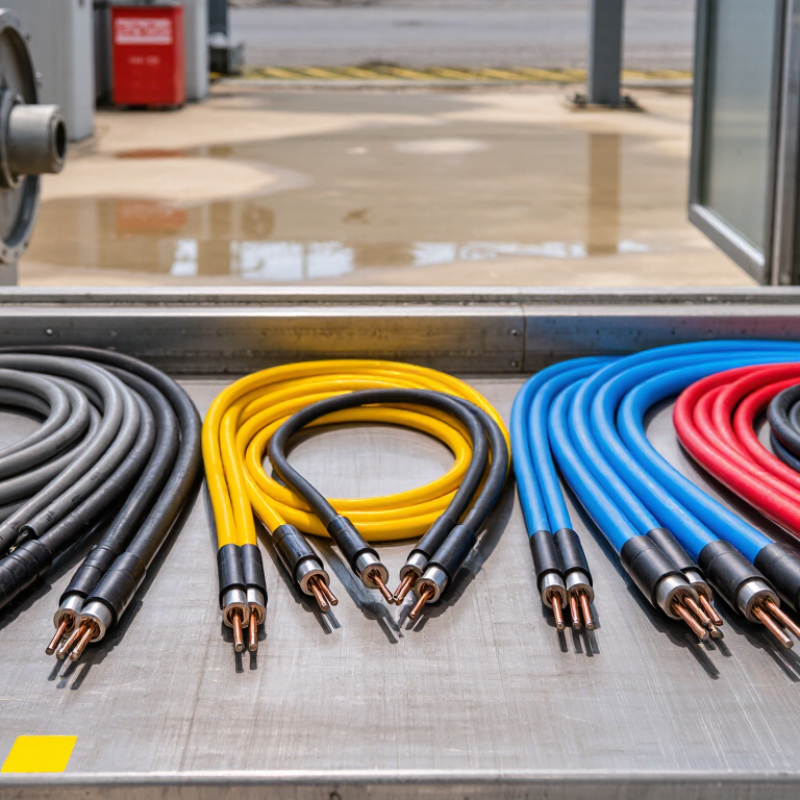
Industrial cables are classified by what they carry, how they are built, and where they operate. Power cables differ from control, instrumentation, and data cables. Conductors may use copper or aluminum, while insulation and sheathing materials affect flexibility, heat tolerance, and resistance to oil or moisture. Construction matters too: a cable might be armored for mechanical protection or designed to bend repeatedly in moving equipment. Small details count.
Buyers can compare voltage rating, conductor size, temperature range, shielding, bend radius, and ingress protection against actual site conditions. A cable routed beside a hot motor needs different thermal performance from one inside a dry control cabinet. Check the applicable test reports and standards, then confirm that the stated ratings match the intended installation. Ask about sample test records when specifications are unclear. No chart captures every installation. I have seen selection tables make a difficult choice look simpler than it is; routing, vibration, and termination quality can change performance. Price matters, but so do traceable production records and consistent inspection. A low-cost option may still fit, yet assumptions should be tested before purchase.
This chart compares representative voltage ratings across common industrial cable classes. Voltage is one classification factor; buyers should also evaluate conductor material, insulation, installation environment, temperature rating, and applicable standards. Values shown are examples, not universal class boundaries.
For global buyers, cable selection starts with the actual operating environment, not a catalog headline. Record voltage, current, ambient temperature, and expected service life. Then consider what the cable will face: oil, moisture, sunlight, repeated bending, or sharp edges. A cable routed beside a moving machine needs different flexibility from one fixed inside a protected cabinet. Small details matter.
Match conductor size and insulation to the load and installation method. Check temperature ratings, bend radius, shielding needs, and fire-performance requirements against the project specification. Confirm that test reports and product documentation cover the exact cable construction being offered. Requirements can differ by destination and industry, so verify applicable standards with the project engineer or qualified compliance team. A familiar rating alone is not enough.
Supply reliability deserves equal attention. Ask about material traceability, batch testing, production lead times, and how substitutions are handled. Request samples when fit, flexibility, or termination quality is uncertain. Check performance under realistic conditions. A cable that looks robust may still resist bending in a cold installation. Easy to miss. Buyers should also compare total installed cost, including connectors, labor, replacement access, and downtime. I would not choose solely by the lowest quotation; that shortcut can become expensive. Still, extra specifications are not automatically better. Select evidence that matches the application, and document any assumptions before ordering.
| Cable Type | Typical Industrial Use | Common Construction Options | Typical Voltage Class | Key Selection Criteria |
|---|---|---|---|---|
| Low-Voltage Power Cable | Power distribution to machinery, panels, pumps, and building services | Copper or aluminum conductors; PVC, XLPE, or other application-specific insulation; optional armor or protective sheath | Commonly 0.6/1 kV in IEC-based systems | Load current, conductor size, installation method, ambient temperature, short-circuit duty, voltage drop, and local wiring rules |
| Medium-Voltage Power Cable | Plant distribution, substations, and large motors | Stranded conductor, semiconductive screens, XLPE insulation, metallic screen, and an outer sheath; armor may be specified | Examples include 6/10 kV, 8.7/15 kV, and 12/20 kV | System voltage and earthing, insulation level, screen design, fault-current rating, route conditions, accessories, and applicable test standard |
| Control Cable | Control circuits, relay wiring, switchgear, and machine interconnections | Multiple insulated cores, often numbered or color-coded; optional braid, foil screen, armor, and flame-retardant sheath | Common ratings include 300/500 V or 450/750 V, depending on design and standard | Core count, conductor flexibility, control-circuit voltage, screening needs, mechanical protection, flame performance, and terminal compatibility |
| Instrumentation Cable | Low-level analog or digital signals between field instruments and control systems | Twisted pairs or triads with individual and/or overall screens; drain wire and protective sheath options | Typically specified for signal circuits rather than power distribution; rated voltage varies by design | Signal type, pair configuration, electromagnetic interference, grounding method, capacitance, route separation, and hazardous-area requirements |
| Variable-Frequency Drive (VFD) Cable | Connections between variable-frequency drives and AC motors | Symmetrical or three-conductor power cores, grounding conductors, overall copper braid or other screen, and robust insulation and sheath | Selected to match the drive and motor system; commonly available in low-voltage ratings such as 0.6/1 kV | Drive output, cable length, screen coverage, grounding and bonding, motor insulation, installation environment, and manufacturer guidance |
| Flexible Industrial Cable | Moving machinery, portable equipment, festoons, and cable carriers | Fine-stranded copper conductors with flexible insulation and sheath; designs may be optimized for continuous flexing or torsion | Varies by cable design and intended application | Flexing frequency, bend radius, travel distance, torsion, oil and abrasion exposure, temperature, and required service life |
| Mining Cable | Powering mobile mining equipment and underground or surface operations | Heavy-duty conductors, insulation, grounding conductors, and reinforced protective layers; some designs are trailing cables | Varies by equipment and mine electrical system | Applicable mining regulations, impact and abrasion resistance, flame performance, moisture, electrical protection, and whether the cable is fixed or mobile |
| Welding Cable | Welding power leads and return connections | Highly flexible stranded copper conductor with a tough, flexible insulating jacket | Specified by conductor size and current-duty conditions rather than one universal voltage class | Welding current, duty cycle, cable length, allowable voltage drop, heat, abrasion, oil exposure, and the applicable safety requirements |
| Fire-Resistant Cable | Circuits required to maintain operation for a specified period during a fire, such as selected alarm or emergency systems | Fire-resistant insulation or barrier system, with conductor and sheath materials chosen for the required circuit-integrity design | Depends on circuit and cable construction | Required circuit function and survival duration, test method, support system, fire and smoke requirements, and local building or life-safety codes |
| Thermocouple Extension or Compensation Cable | Connecting thermocouples to temperature instruments and control equipment | Matched alloy conductors or specified compensating alloys, with insulation and sheath selected for the environment | Low-level measurement circuit; voltage rating depends on the cable design | Thermocouple type, polarity, temperature range, extension-versus-compensation requirements, shielding, and measurement accuracy |
Selection note: Voltage ratings, materials, and test requirements vary by cable design and national code. Confirm the applicable IEC, EN, UL, NEC, or other regional requirements, together with the project specification, before procurement.
Industrial cable selection starts with the operating environment, not the catalog. The IEA’s 2023 report, Electricity Grids and Secure Energy Transitions, says annual grid investment needs to exceed $600 billion by 2030. That expansion makes reliable cable choices increasingly important. Still, the right design depends on heat, movement, moisture, chemicals, and electrical noise.
Ten types cover many common needs. PVC cable suits general fixed wiring; XLPE handles higher conductor temperatures. Rubber cable tolerates repeated flexing, while armored cable adds mechanical protection. Control cable carries switching signals; shielded instrumentation cable helps protect low-level measurements from interference. VFD cable is designed for inverter-fed motors. Fire-resistant cable can maintain specified circuit functions under tested fire conditions. Thermocouple cable carries temperature-sensor signals, and fiber-optic cable transmits data without electrical interference. No type wins everywhere.
The IEA’s Renewables 2024 report forecasts nearly 5,500 GW of renewable capacity additions during 2024–2030. More generation often means more power, control, and data connections, but site conditions still decide the cable build.
Check voltage, conductor size, bend radius, temperature rating, shielding, and approved test standards. A cable that survives a brief pull may fail after years of vibration. Easy to overlook.
Confirm the installation details with a qualified engineer; cable labels alone do not tell the whole story.
Industrial cable selection starts with the duty, not the catalogue. Low-voltage power cables suit pumps, fans, and control panels; medium-voltage XLPE cables feed larger motors and site distribution. IEC 60502-1 and IEC 60502-2 provide relevant construction requirements for these voltage classes.
For a motor beside a variable-frequency drive, screened VFD cable helps manage electromagnetic interference. Shielded instrumentation cable protects low-level sensor signals, while flexible cable handles repeated movement on cranes and robotic equipment.
Heat changes everything.
The International Energy Agency’s Electricity Grids and Secure Energy Transitions report says annual grid investment must rise above US$600 billion by 2030, more than doubling current levels. It also estimates that 80 million kilometres of grids must be added or replaced by 2040.
That expansion raises demand for dependable power and communication links, including fibre-optic cables for industrial networks and subsea cables for offshore connections. Fire-resistant circuits may be essential for maintaining selected safety systems during a fire; verify the required test conditions against project specifications and applicable standards.
A recurring blind spot is cable routing: a correctly rated cable can still overheat when bundled tightly beside hot process piping. Check ambient temperature, bend radius, shielding, and installation method before approving a specification.
For the 10 best industrial cables in 2026, start with the project specification, not the product label. Check the exact standard and edition, rated voltage, conductor class, temperature range, and required fire performance. IEC 60228 defines conductor classes and resistance limits; IEC 60502-1 covers power cables rated 1 kV and 3 kV. Confirm that the supplier’s test documents match the cable size and construction you will actually buy. Labels are not proof. Ask for routine-test results, batch traceability, and measured conductor resistance. A certificate can look convincing while covering a different product range.
Global compatibility needs practical checks. Compare voltage and frequency requirements, metric conductor sizes, insulation materials, and local installation conditions. A cable suitable indoors may fail outdoors under UV exposure, heat, oil, or moisture. The International Energy Agency’s 2023 Electricity Grids and Secure Energy Transitions report says about 80 million kilometres of grids must be added or refurbished by 2040. That scale makes consistent documentation and dependable supply important. Still, paperwork cannot predict every installation problem; verify samples and review the test scope with a qualified engineer. A small mismatch in cable diameter or gland size can delay a whole project.
